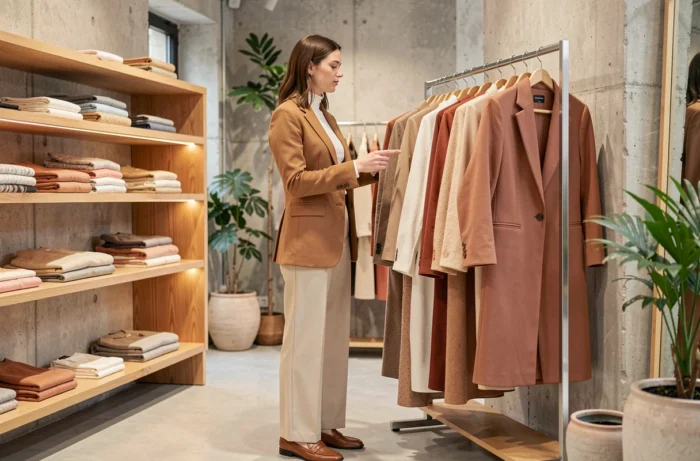
Since September 1, 2026, buying clothing in France is no longer just about choosing a cut or a color. A financial penalty now targets ultra-fast fashion brands, and this measure is gradually changing price benchmarks for consumers. Seasonal fashion trends are therefore set within a new regulatory context, where the durability of a piece weighs as heavily as its aesthetics in the purchasing decision.
Penalty on ultra-fast fashion: what the French law changes for your wardrobe
The decree published on August 28, 2026, by the Ministry of Ecological Transition establishes a penalty that can reach 50% of the pre-tax price of an item, capped at 12 euros per piece in 2026 and 19.50 euros in 2030. The mechanism does not penalize a specific fabric or cut: it targets brands that market a very large volume of references while offering few incentives for repair.
The measure explicitly targets platforms like Shein or Temu. For the rest of the market, the direct impact on checkout prices remains limited. However, the signal sent to more traditional retailers is clear: offering a tailoring or repair service becomes a selling point, not just an ecological gesture.
Field reports vary on the actual short-term effect of this penalty. Some retailers absorb the surcharge, while others partially pass it on. For those looking to explore fashion on Mademoiselle Emma, this context invites consumers to look beyond the displayed price and consider the actual usage duration of a piece before adding it to their daily outfit.

Autumn 2026 trendy colors and cuts: pieces that withstand seasonal sorting
This season’s runways have showcased more muted palettes than previous springs. Terracotta shades, deep blues, and warm beiges dominate women’s wardrobes, far from the explosion of bright colors that characterized previous collections.
In terms of cuts, the oversized blazer maintains its place, but the real novelty lies in the return of structured shoulder garments. Long-sleeved midi dresses and sharply pleated straight trousers create a style suitable for both the office and evening outings.
The question to ask in front of these fashion trends is not “Is this piece fashionable?” but rather: Will this cut remain in my wardrobe in two years? A well-cut wool blazer can last several seasons. An ultra-thin synthetic top bought at a bargain price will likely end up at the back of a closet before the next winter.
Materials that make a difference in everyday life
Linen, merino wool, and thick cotton are making a comeback in autumn-winter collections. These materials share a common point: they can be repaired. A seam opened on a linen shirt can be fixed in ten minutes. The same tear on a cheap synthetic fabric often condemns the garment.
Choosing natural and repairable materials is not a militant choice. It’s a cost-per-wear calculation: a merino sweater worn fifty times is cheaper than an acrylic sweater worn ten times and then thrown away.
Advertising restrictions and fast fashion: what changes in 2027 for consumers
French regulations do not stop at the penalty. Starting January 1, 2027, advertising for ultra-fast fashion will be restricted in France. This measure concerns both direct and indirect promotion, including on social media. The available data does not yet allow for measuring the effect of this restriction on purchasing habits, but the legal framework is established.
At the same time, the European Union is pushing for an ambitious goal: all clothing sold in Europe must meet circularity criteria by 2030. In practical terms, this means that a garment must be designed to be recycled, repaired, or resold, and not just worn and then discarded.
To create a sustainable personal style, these regulatory constraints outline a fairly concrete framework:
- Check if the brand offers a repair or alteration service, which becomes a quality indicator as much as the fabric itself
- Look at the number of references offered by a retailer: a plethora of catalog items often signals a fast renewal model, more exposed to the penalty
- Favor pieces whose resale on the second-hand market remains possible, which implies durable materials and fairly classic cuts to find buyers

Building a sustainable look without giving up fashion trends
Adapting your look to the season’s trends while considering these new rules is not contradictory. The principle is simple: invest in basics, experiment with accessories. A well-cut wool coat, quality straight jeans, and a pair of leather shoes form a foundation that transcends seasons.
Accessories, on the other hand, allow you to incorporate the colors and patterns of the moment at a lower cost. A silk scarf in terracotta tones, a braided belt, or a recycled canvas bag is enough to update an outfit without multiplying clothing purchases.
The cost-per-wear reflex
Before each purchase, dividing the price by the number of times the piece will actually be worn provides a more reliable indicator than the displayed price. A dress at 150 euros worn thirty times costs 5 euros per use. A top at 8 euros worn twice costs 4 euros per wear, not counting its environmental impact or any potential penalty passed on to the price.
This calculation is nothing new, but French regulations now provide a tangible framework for it. Brands that focus on repairable pieces and tight collections are those whose prices will remain the most stable in the face of upcoming regulatory surcharges by 2030.
Everyday style is built less on the accumulation of clothing than on the choice of pieces that last, combine, and can be repaired. This season’s fashion trends are pointing in that direction, and French law is accelerating the movement.