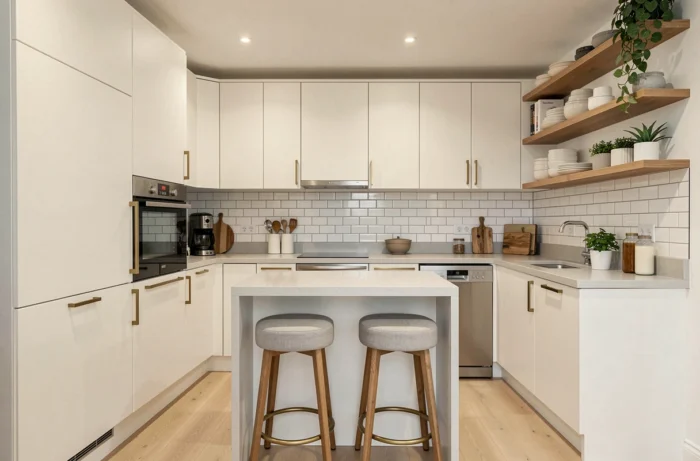
Designing a 10 m² kitchen requires making choices between expenses, the relative weight of which varies depending on the layout of the home, the condition of existing networks, and the desired level of finish. The kitchen budget for this area ranges from a few thousand euros for a targeted refresh to over 20,000 euros for a high-end custom project, including appliances.
Understanding where the money actually goes, item by item, helps avoid unpleasant surprises during the project.
VAT and taxation: the trap that skews the kitchen budget from the start
Even before choosing furniture or a countertop, the tax question affects the actual cost of the project. In a home completed for more than two years, improvement and renovation work can benefit from a 10% VAT instead of 20%. This reduction does not uniformly apply to all elements of a kitchen.
Appliances, including a built-in oven or refrigerator, remain subject to 20% VAT. For equipment to qualify for the reduced rate, it must be incorporated into the structure. Tiled backsplashes or masonry countertops fall into this category, but not the dishwasher placed under the counter.
A detail often overlooked concerns the direct purchase of materials by individuals. When you buy the equipment yourself, it is billed at 20%. Only the installation performed by a professional can, if eligible, benefit from the reduced rate. A detailed guide on kitchen design on Maison Sublime allows you to visualize these trade-offs between bundled supply-installation and separate purchases. The VAT difference can represent several hundred euros on a complete renovation project.

Countertops, backsplashes, and facades: materials that shift the price
In a 10 m² kitchen, furniture and surfaces represent the most variable expense. The choice of materials for the countertop, backsplash, and cabinet facades creates significant differences at equal surface area.
The countertop as a marker of quality
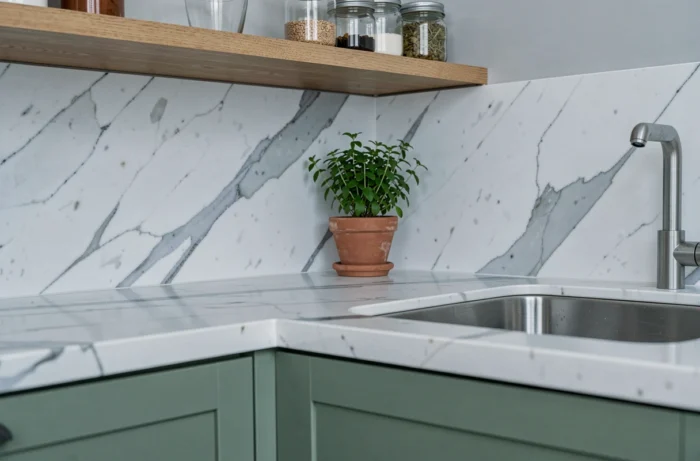
A laminate countertop costs significantly less than a quartz or granite model. For 10 m² of kitchen, the required countertop length depends on the layout (linear, L-shaped, U-shaped). The material of the countertop often determines the perceived quality of the whole, making it an area where compromises are most visible.
Field reports differ on the comparative durability of quartz and granite in intensive daily use. Both resist heat and scratches well, but their maintenance and purchase prices differ.
Backsplashes and facades: visible finish, discreet budget
The backsplash protects the wall behind the cooking area and sink. Options range from classic tiling to tempered glass, including stainless steel. Each material involves a distinct supply and installation cost. The facades of kitchen furniture follow the same logic: a melamine panel is not priced the same as a wood veneer or a matte lacquer finish.
- Laminate and melamine: entry-level, easy to replace, shorter lifespan in humid environments
- Quartz and resin: mid-range to high-end, stain-resistant, professional installation recommended
- Solid wood and lacquer: high-end, regular maintenance required, marked aesthetic appeal
- Stainless steel and tempered glass (backsplash): easy to clean, sensitive to fingerprints, technical installation
Appliances and connections: the invisible budget of a 10 m² kitchen
Competitors often advertise a price “excluding appliances.” In a real project, appliances account for about one-third of the total budget. Oven, cooktop, hood, refrigerator, and dishwasher form a set whose cumulative weight is significant, especially in mid-range or high-end kitchens.
The choice between gas and induction for cooking is not limited to the price of the appliance. If the home retains a gas subscription only for cooking, the recurring cost of this subscription should be compared to the one-time additional cost of converting to induction. This conversion often involves upgrading the electrical panel and dedicated circuit.
Plumbing and electricity: quotes that inflate
Moving a sink or adding a water point significantly changes the budget. Plumbing and electrical work in a 10 m² kitchen depend on the condition of existing networks. An older home with lead pipes or an undersized electrical panel incurs compliance costs that do not appear in kitchen catalogs.
Electrical upgrades represent an unavoidable expense when transitioning from an old configuration to a modern kitchen equipped with energy-consuming appliances. A dedicated circuit for the cooktop, another for the oven, a third for the dishwasher: available data does not allow for a universal figure, but this expense often exceeds initial estimates.
Flat-pack kitchen, custom-made, or kitchen designer: which purchase model for 10 m²
The purchase channel weighs as much as the choice of materials. A flat-pack kitchen bought at a DIY store and assembled by oneself represents the least expensive option, but requires skills in installation and connections.
Hiring a kitchen designer who integrates design, supply, and installation simplifies the project. The supply-installation package generally includes reduced VAT on eligible items, which narrows the gap with separate purchases. However, the designer’s margins increase the overall cost compared to a direct purchase from an independent craftsman.
- Flat-pack kitchen (large store): lowest budget, assembly required, limited warranty on installation
- Integrated kitchen designer: custom design, single point of contact, mid to high budget
- Separate purchase with installation craftsman: flexibility on suppliers, coordination to manage oneself
For a surface area of 10 m², the L-shaped layout remains the most common and functional. A central island, often highlighted in trends, requires minimal clearance that limits its relevance in this size. Field reports differ on this point: some layouts incorporate a narrow island with dual function (storage and additional workspace), while others forgo it due to lack of space to move around.
The final budget for a functional and trendy 10 m² kitchen is therefore built around three concrete trade-offs: the level of finish of visible surfaces, the chosen purchase channel, and the extent of technical work on existing networks. Each combination produces a radically different budget for strictly identical surface area.