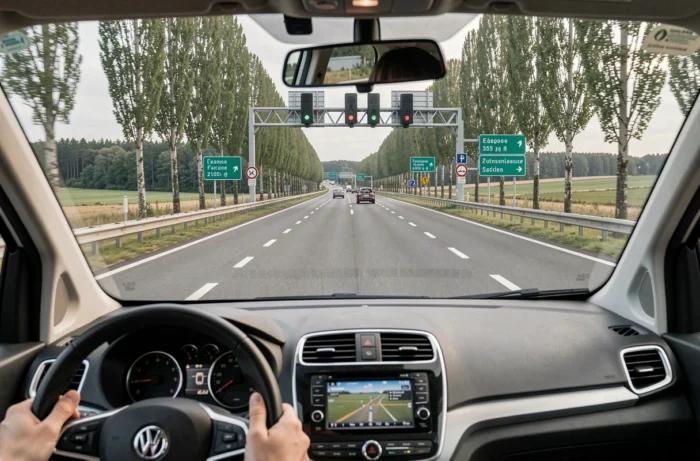
The French road network offers two long-distance travel options: the toll highway and the non-toll expressway (national 2×2 lanes, free highway funded by the State or local authorities). The choice between these two options is not just a matter of price versus time. It involves parameters of consumption, mechanical wear, and safety that we detail here.
Free-flow tolls and new pricing constraints on highways
The deployment of free-flow tolls changes the game for motorists used to traditional barriers. Since December 2024, the A13 operates without physical barriers: the driver pays after passing through, online, via a badge or through the Nirio network. This system smooths traffic at former slow points, but it creates a real risk of forgetting followed by penalties.
Here we find practical information on Actu Mécanique that details these pricing changes.
On the pricing side, operators have applied an average increase of 0.86% as of February 1, 2026. The increase seems moderate in percentage terms, but it accumulates year after year. On a Paris-Lyon trip, the cost difference with a route via the A77/A79 and then the N79 (partially free) deserves to be recalculated each season.
Actual consumption and mechanical wear: highway versus expressway
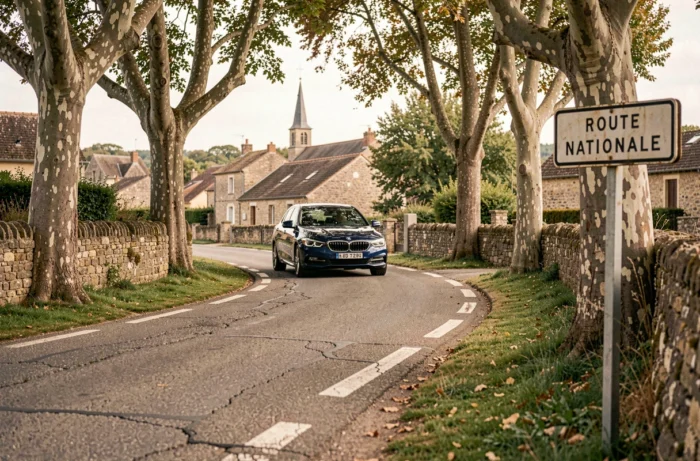
Driving at 130 km/h on the highway consumes significantly more fuel than a trip at 110 km/h on a national 2×2 lane road. Aerodynamic resistance increases with the square of the speed: going from 110 to 130 km/h increases consumption non-linearly. Over a journey of several hundred kilometers, the fuel difference can offset part of the saved toll, or conversely widen the gap in favor of the national road.
Mechanical wear also differs. The highway puts less strain on brakes and steering due to a straight route and controlled gradients. An expressway, even in 2×2 lanes, requires more braking (roundabouts, residual intersections, urban crossings). Brake pads, tires, and suspensions feel the impact over the long term.
Overall cost per kilometer
We recommend reasoning in terms of total cost per kilometer: fuel, tolls, wear on consumables. A simple spreadsheet with distance, average consumption noted on the cruise control, and toll rates is sufficient. Public GPS applications rarely display the cost of consumables, which skews the comparison between “free” routes and toll routes.
Construction and closures: a factor that reverses the advantages
Scheduled construction can make the highway less attractive than the national road, sometimes for several months. The closure of the Saint-Cloud tunnel on the A13, planned from November 2026 to the end of August 2027, is a case in point. As compensation, a 50% reduction on the Montesson toll is planned for certain periods and certain routes, but this discount does not cover the time lost in detours.
On the non-toll national network, construction is managed by the DIR (Interdepartmental Road Directors). The road event data published on data.gouv.fr allows for checking ongoing construction sites. We observe that few motorists utilize this source before planning a long trip.
Anticipate rather than suffer
Before departure, checking three elements is enough to avoid unpleasant surprises:
- The active construction sites on the intended highway (concessionaire’s site or Bison Futé)
- The construction on the alternative national road (data.gouv.fr portal, road event section of the non-toll national network)
- Real-time traffic conditions, particularly at junctions between the toll network and the free network where bottlenecks form due to the funnel effect
Road safety: different risk profiles depending on the network
The toll highway remains the safest network per kilometer traveled in France. The physical separation of traffic directions, the absence of at-grade intersections, and the width of the lanes reduce the risk of serious accidents. The national 2×2 lanes offer an intermediate level of safety, significantly higher than traditional two-way roads but lower than the highway.
On national roads, the speed differential between heavy trucks and light vehicles creates risky overtaking situations, especially on sections with one lane in each direction.
Fatigue and driving time
A trip on a fast national road requires more active attention than a monotonous highway journey. The cognitive load is higher (variable signage, lateral insertions, changes in speed limits). For a tired driver, the highway remains safer despite the monotony, provided that regulatory breaks are respected.
The choice between toll highway and fast national road depends on the specific journey, the vehicle, and the moment. A calculation of overall cost, a check of ongoing construction, and an honest assessment of one’s fatigue level are worth more than any general rule. On certain routes like the A77/N79 heading south, the national road competes with the highway in terms of time and comfort. On others, the time savings on the highway justifies every euro of toll.