
A mole is a cluster of melanocytes embedded in the dermis, sometimes reaching its deep layer. This cellular structure explains why no topical method applied on the surface can reliably make it disappear. We recommend understanding this biological limit before considering any approach, whether natural or medical, to remove a mole.
Melanocytes and Dermal Depth: Why Topical Remedies Fail on a Mole
Nævi fundamentally differ from superficial lesions like warts or post-inflammatory brown spots. A wart is a keratinous proliferation limited to the epidermis, accessible to keratolytic agents. A mole, on the other hand, involves melanocytic cells that can extend into the reticular dermis, well beyond the reach of a mild acid or a vegetable oil.
When applying apple cider vinegar or lemon juice on a nævus, the acid attacks the surrounding epidermis without reaching the deep melanocytes. The usual result: a superficial chemical burn, a scab, then a pigmented or depigmented scar, while the melanocytic cells remain in place beneath the lesion.
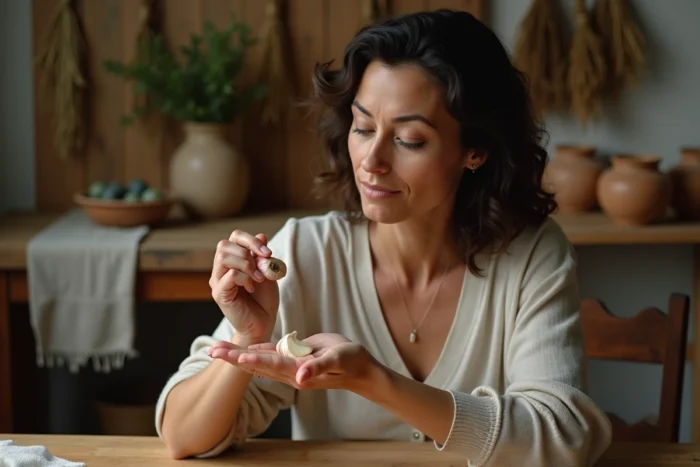
Castor oil, often mentioned in forums, has not been the subject of any clinical studies demonstrating an effect on nævi. Its emollient properties act on the stratum corneum, not on a dermal cell cluster. The same observation applies to baking soda, garlic, and various poultices.
There are ways to seek to remove a mole naturally, but understanding this biological barrier remains a prerequisite for any reasoned approach.
Concrete Risks of Home Methods on the Skin and Diagnosis
Any alteration of a nævus outside a medical framework compromises its histological reading. Dermatology societies remind us that complete surgical excision is the gold standard, even for benign lesions. The reason is simple: only a complete sample allows for reliable anatomical pathology analysis.
Pathological Healing After Chemical Burn
Concentrated apple cider vinegar, crushed garlic, or acidic solutions cause uncontrolled tissue necrosis. On the face, the thin skin reacts with intense inflammation that can generate a hypertrophic scar or a persistent pigmentation disorder. We observe that these scars are often more visible than the initial mole.
Masking an Early Melanoma
An atypical nævus that evolves may present the ABCDE criteria (asymmetry, irregular borders, heterogeneous color, increasing diameter, recent evolution). Burning or irritating this lesion alters its surface appearance without affecting the deep cells. The dermatologist then loses visual landmarks for dermoscopy, and the melanoma diagnosis may be delayed by several months.
- Tying off with dental floss causes partial necrosis that leaves residual cells deep down, making histological analysis incomplete.
- Over-the-counter cryotherapy devices are calibrated for warts, not for nævi. Their application on a mole creates a cold burn without guaranteeing complete removal.
- Repeated application of lemon juice on a sun-exposed nævus increases the risk of photosensitization and residual staining.
Teledermatology and Digital Screening Before Any Aesthetic Approach
A recent trend is changing how patients approach their moles. Teledermatology platforms allow for an initial visual triage before the physical consultation. This step, which has significantly developed in recent years, reduces the time between the first concern and specialized advice.
A dermatologist can evaluate a nævus via dermoscopic photo remotely and refer for excision if the criteria justify it. This consultation does not replace a complete clinical examination, but it filters purely aesthetic requests from cases requiring prompt management.
For moles deemed unaesthetic but strictly benign after evaluation, the dermatologist offers excision with a scalpel or shaving depending on the location and depth. These procedures, performed under local anesthesia, are quick and systematically allow for tissue to be sent for anatomical pathology.

Natural Skin Care That Has a Real Role Around Moles
While no natural substance can remove a nævus, certain practices act on the surrounding skin condition. We recommend distinguishing between what pertains to skin care and what pertains to the removal of a lesion.
Sun protection remains the most effective measure to limit the appearance of new nævi and monitor existing ones. A broad-spectrum sunscreen, applied daily to exposed face and body, reduces UV aggression on melanocytes.
Vegetable oils like rosehip oil or black seed oil help maintain hydration and elasticity of the skin around pigmented areas. They do not act on the mole itself, but on the overall quality of the skin tissue.
- Cleaning the skin with a moisturizing soap rather than a stripping product preserves the hydrolipidic film and limits irritation around nævi in friction areas.
- Avoiding direct sun exposure during peak UV intensity hours slows the aging of pigment cells.
- Monitoring moles using the ABCDE method every three months allows for early detection of suspicious changes.
A mole that changes shape, color, or size warrants an immediate consultation, regardless of the treatment considered. Medical excision remains the only validated method for removing a nævus, and sun prevention is the only natural lever with a demonstrated impact on long-term skin risk.