
A child running in circles on a Wednesday afternoon often signals that the proposed activities lack variety. Entertaining and engaging your children daily doesn’t require a colossal budget or an overloaded schedule. A few well-chosen ideas, rooted in free play and sensory discovery, are enough to transform mundane moments into real learning experiences.
Daily brain activation: micro-sequences that change everything
Have you noticed that a restless child sometimes calms down by walking on an imaginary beam or clapping their hands to a precise rhythm? It’s no coincidence. Brain activation exercise programs, similar to brain gym, offer short sequences of five to fifteen minutes to integrate into family routines.
The principle is simple: combine a body movement with a cognitive task. For example, the child balances on one foot while recounting their day. Or they draw a lying figure eight in the air (the “lazy eight”) while counting backward. These exercises, which require no equipment, work on concentration, self-regulation, and frustration management.
The idea is not to add a chore to the schedule. On the contrary, these micro-sequences can be slipped in before breakfast, after school, or just before homework. Many families also use them as a calming ritual between two more intense activities. Cross-crawling (right arm with left knee, and vice versa) is a good starting point for children as young as three or four years old.
To find other resources suitable for awakening toddlers and family games, platforms like poupala.fr gather a selection of toys and activities designed by age group.
Nature games with smartphones: awakening curiosity outdoors
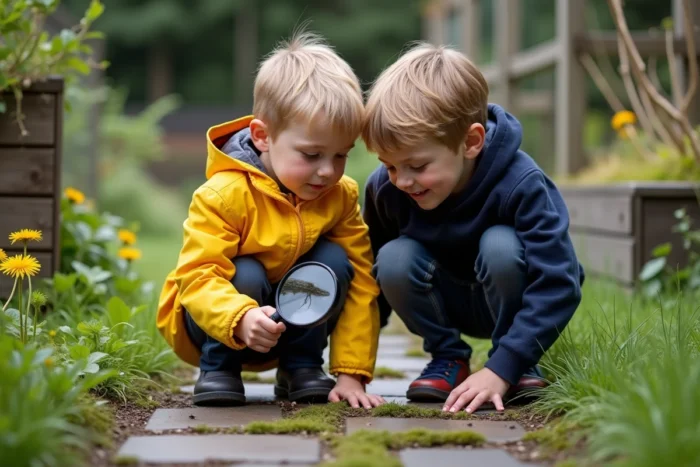
Taking children outside is a classic. Giving them an observation mission transforms a walk into a true awakening workshop. One particularly effective approach is to use a plant or bird recognition app during outings.
The process is accessible even to the youngest: the child takes a photo of a flower, leaf, or insect, and the app identifies the species. This small action triggers a cascade of questions. Why does this plant grow here and not there? What is the name of that singing bird?
This type of outdoor game has multiple benefits:
- It channels screen time into active and educational use, rather than passive consumption
- It develops the child’s scientific vocabulary without a lecture, through direct discovery
- It creates an observation notebook that the family can enrich over the seasons by noting the species spotted
No need to live near a forest. An urban park, a community garden, or even the edge of a sidewalk provides enough biodiversity to keep a curious child occupied for a good half hour.
Emotion and imagination workshops at home
Games that engage the imagination are not limited to drawing or modeling clay. A simple yet effective workshop involves asking the child to invent a story using three randomly chosen objects from around the house. A wooden spoon, a mismatched sock, and a pebble picked up at the park become the characters of an improvised tale.
This type of exercise works on narrative construction and emotion management. The child learns to structure a beginning, middle, and end. They also project their own feelings onto the characters, which opens a natural dialogue space with the parent.
Finger games and shared breathing
For the youngest (from baby to three years old), finger games remain an underestimated awakening tool. Each finger represents a character, an animal, or a number. The adult mimics, the child imitates, then invents their own variation.
Shared breathing works on the same principle of shared relaxation. Parent and child sit facing each other, inhale while raising their arms, exhale while lowering them. Three minutes are enough to refocus the attention of a distracted child. This ritual also works very well before bedtime.

Toys and board games: choosing those that truly stimulate
Not all toys are equal when it comes to awakening. A toy that does everything for the child (lights, sounds, automatic movements) grabs attention but does not nourish it. In contrast, a simple construction game or a cooperative board game encourages the child to think, negotiate, and anticipate.
Here are some criteria for choosing games that combine fun and stimulation:
- The game allows for multiple ways to play, without imposing a single scenario
- It involves interaction with another player (parent, sibling) rather than passive solitary use
- It adapts its difficulty to the child’s age, with rules that evolve over the course of play
- It engages at least two skills among memory, logic, fine motor skills, or language
Family board games also create shared relaxation moments where everyone disconnects. Even a ten-minute game before dinner establishes a ritual that children request themselves.
Alternating quiet time and physical activities
A final point that many parents overlook: the alternation between quiet games and physical activities conditions the quality of awakening. A child who goes through three creative workshops without moving will eventually lose interest. Conversely, too much motor stimulation without a return to calm generates excitement that is difficult to channel.
Alternating a brain activation sequence in the morning, a nature outing in the afternoon, and an imagination workshop in the evening creates a rhythm that most children naturally adopt. The goal is not to fill every minute but to offer varied times where play, discovery, and relaxation each find their place.