
When opening Tistou the Green Thumbs with a CE2 class or during evening reading, the first difficulty is not the vocabulary. It is the children’s reaction to chapters that talk about prison, illness, and war in a book supposed to be wonderful. The tale by Maurice Druon, published in 1957, remains a demanding text that requires genuine reading support.
Reading Tistou the Green Thumbs aloud: what engages and what blocks
We often underestimate the gap between the poetic register of the text and the very raw situations it describes. Tistou discovers a hospital, a prison, a battlefield. The tone remains light, almost playful, but the social realities are stark.
It is precisely this tension that makes reading aloud so effective. The chapter titles, crafted like puns, provoke spontaneous reactions. The child listening perceives the contrast between the wonderful (flowers that grow instantly) and the real (misery, violence). This gap opens discussions that a purely realistic narrative would not trigger as easily.
For those seeking an analysis and reading guide for Tistou the Green Thumbs, the most productive starting point remains this narrative mechanism: the wonderful serves to name what realism renders too brutal for a young reader.
The vocabulary itself does not pose as many comprehension problems as it does issues of register. Druon uses elevated, sometimes ironic expressions that require a mediating adult capable of explaining the second degree. An eight-year-old understands the word “cannon,” but not necessarily the irony when the author describes the manufacture of weapons as a respectable activity.

Maurice Druon and writing for youth: an unexpected author
Maurice Druon is best known for The Accursed Kings, a historical saga intended for adults. He also co-wrote, with his uncle Joseph Kessel, the lyrics of the Song of the Partisans during the Resistance. Elected to the Académie française in 1966, he served as Minister of Cultural Affairs in 1973-1974.
Tistou the Green Thumbs is his only children’s tale. In the preface, Druon explains that Tistou “does not understand why men cannot agree to live in goodness,” and that he himself has “not yet understood or accepted this incapacity.” This statement anchors the narrative in a personal stance rare for such an institutional author.
The book was conceived from the start in collaboration with illustrator Jacqueline Duhême. It is not a text to which images were added afterward: the text and illustrations form a common project. This visual dimension, often overlooked in reading guides, changes the way the tale is approached in class.
Reading guide for Tistou the Green Thumbs: the axes that work in class
School reading guides generally focus on chapter summaries and character lists. We can go further by structuring the study around three concrete axes.
The power of Tistou as a metaphor for civic action
Tistou transforms the prison into a garden, the hospital into a flower greenhouse, the battlefield into a meadow. Each intervention of his green thumbs responds to a specific place of suffering. This repetitive pattern allows children to identify a narrative structure, but also to debate: does making flowers grow on cannons really prevent war? The tale poses the question without answering it definitively.
The figure of the gardener Moustache as an initiatory guide
Moustache is the one who discovers Tistou’s gift and accompanies him without ever directing him. In pedagogical terms, he is a model of transmission through direct experience rather than formal instruction. Tistou fails at school (he falls asleep in class) but learns everything in the garden. This reversal of the relationship to education constitutes a particularly rich discussion point with cycle 3 students.
The moral dimension without moralism
Druon avoids the trap of the moralistic tale. The narrative never says “we must protect nature” or “war is bad.” It shows a child acting according to his instinct, and the consequences of these actions on the adult world. Reactions vary on this point depending on the readers’ ages: younger ones focus on the magical power, while older ones perceive the social critique.
Available editions and resources to support the reading of Tistou
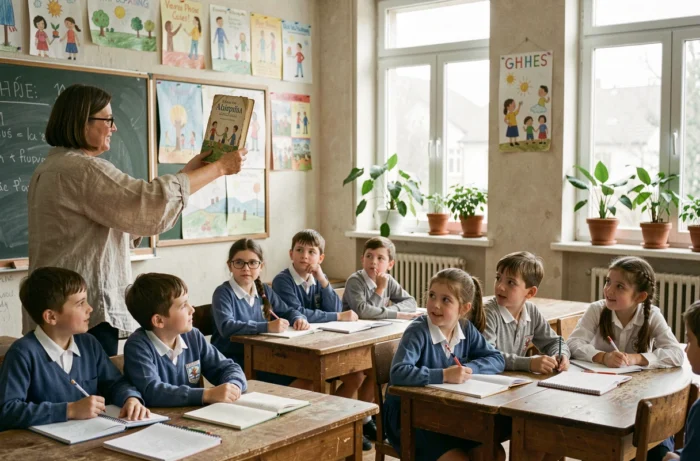
The text exists in several formats chosen for different reasons. The illustrated edition from Gallimard Jeunesse retains Jacqueline Duhême’s drawings and is suitable for guided reading starting from CE1. A pocket edition, classified as a school novel, was published by Larousse in February 2017. This edition includes educational materials (notes, questionnaires) useful for independent work starting from CM1.
The choice between these two formats depends on the usage:
- The illustrated Gallimard edition works better for read-aloud sessions or shared reading, thanks to the text-image link conceived from the start
- The Larousse school edition is suitable for written comprehension sequences, with its integrated questions and accessible price for class sets
- The text continues to be performed on stage in public readings and theatrical adaptations for youth, which opens an interdisciplinary work avenue between French and performing arts
Druon’s tale holds a unique place in French children’s literature. Its uniqueness lies in the alliance between an adult political perspective and a narrative accessible from the age of seven. While other philosophical tales for children choose animal allegory or interplanetary journeys, Tistou remains rooted in an ordinary city, with a factory, a garden, and neighbors.
It is this proximity to everyday life that makes the wonderful so impactful, and explains why the text still resonates in classrooms, nearly seven decades after its publication.