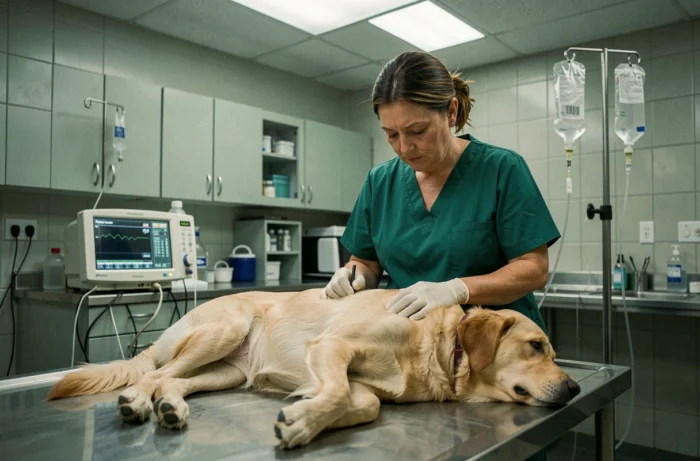
Most pet owners leave the clinic after entrusting their animal without knowing exactly what happens between the closing of the doors and the next morning. The level of monitoring, care protocols, and internal organization vary significantly from one facility to another. Understanding what actually occurs during a night at the veterinarian allows for asking the right questions before leaving a dog or cat for hospitalization.
Nocturnal Monitoring in Veterinary Clinics: What the Protocols Provide
Nocturnal monitoring in veterinary clinics does not rely on a single standard. Some facilities maintain a veterinarian and a veterinary technician (ASV) on site all night. Others operate with intermittent presence, sometimes limited to rounds every two to four hours.
In veterinary hospitals or emergency clinics, staff remains on site continuously. These teams ensure active monitoring: heart rate, respiratory rate, temperature, blood pressure for critical cases. The animal is re-evaluated at regular intervals, and each observation is recorded in a follow-up sheet.
In general practice clinics, the reality is different. The animal may be left alone between the end of the evening and the opening the next morning, with a surveillance camera as the only relay. We recommend asking the veterinarian directly: will someone be physically present tonight? The answer determines the actual level of security of the hospitalization.
To better understand what happens during a night at the veterinarian, it is important to distinguish between passive hospitalization (simple observation) and active hospitalization (continuous intensive care).
Nocturnal Intensive Care: Infusion, Analgesia, and Continuous Reevaluation
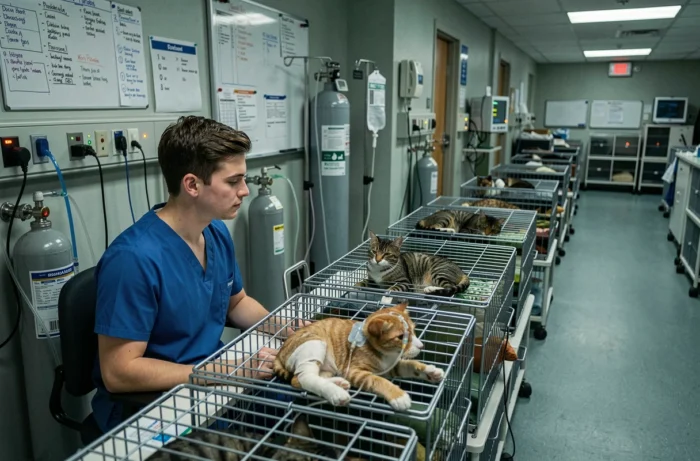
A night of hospitalization is not just about placing an animal in a kennel and waiting for morning. Care is continuously adjusted according to clinical progression. A cat in acute renal failure will receive intravenous fluid therapy, with the flow rate adjusted based on its urine output and hydration status. A dog operated on for gastric torsion will be monitored for any post-operative cardiac arrhythmia.
Analgesia is part of the most regulated nocturnal protocols. Pain reevaluation relies on validated scales (Glasgow scale for dogs, Montreal scale for cats). The nursing staff adjusts analgesic doses, switches from an opioid to a non-steroidal anti-inflammatory drug, or adds an adjunctive molecule if the response is insufficient.
Nocturnal care may also include:
- Oxygen therapy in an oxygen cage or via a nasal tube for animals in respiratory distress
- Assisted feeding via a nasoesophageal tube when the animal refuses to eat for more than 24 hours
- Blood tests for monitoring (ionogram, blood sugar) to adjust infusions in real-time
- Administration of antibiotics intravenously according to a strict hourly schedule
Each nocturnal intervention is timestamped in the medical record. This follow-up allows the daytime veterinarian to resume care with a complete view of the progression.
Separation of Hospitalized Animals: Sanitary Organization of Facilities
The layout of hospitalization facilities has a direct impact on the well-being of the animal and the prevention of nosocomial infections. Structured clinics separate patients based on several criteria.
Dogs and cats are housed in distinct areas. The stress of a hospitalized cat significantly increases when it perceives the presence of dogs nearby. Some clinics have a closed, soundproof cat ward with dim lighting and calming pheromones (Feliway).
Beyond species separation, contagious animals (parvovirus, severe coryza, ringworm) are isolated in dedicated kennels with a reinforced disinfection protocol between each patient. Staff changes gowns and gloves before entering these areas.
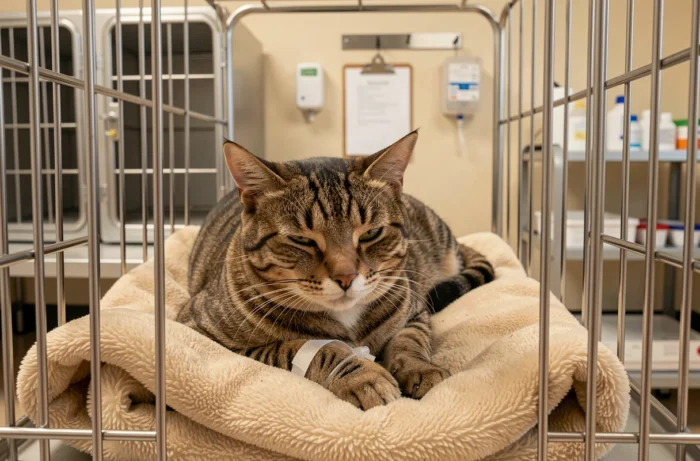
New pets (NAC) pose additional constraints: rabbits and ferrets require suitable cages, controlled ambient temperature, and specific food available overnight.
Phone Triage and Screening Before Nocturnal Admission
In emergency facilities, a night at the veterinarian often begins before arriving at the clinic. A triage call allows for sorting cases and directing the owner. The on-call veterinarian assesses the severity over the phone, gives first aid instructions if necessary, and assigns a time slot for arrival.
This prior triage serves two functions. It allows for preparing the appropriate equipment (oxygen cage, transfusion kit, surgical tray) before the animal’s arrival. It also prevents overcrowding of the service with non-urgent cases that can wait until the next morning’s opening.
We observe that owners who call before coming in receive faster and more targeted care. Arriving unannounced at an emergency clinic can lead to longer wait times, especially if the team is already managing a critical case.
What to Check Before Entrusting Your Animal for the Night
Not all nocturnal hospitalizations are equal. Before leaving your dog or cat, ask these questions to the veterinary team:
- Will a qualified person be physically present all night, or is monitoring solely reliant on cameras?
- How often will the animal’s vital signs be checked?
- What care is planned for the night (infusion, analgesia, feeding) and is their cost included in the hospitalization package?
- Is it possible to receive updates in the evening or the next morning before opening?
The cost of a night of hospitalization varies depending on the facility, the severity of the case, and the care administered. A simple observation hospitalization costs significantly less than a stay in intensive care with continuous monitoring, infusions, and additional examinations.
The choice of clinic for nocturnal hospitalization deserves as much attention as the choice of the treating veterinarian. A facility with staff on site at night offers unparalleled responsiveness in the face of sudden deterioration, which remains the main risk of a night in hospitalization.