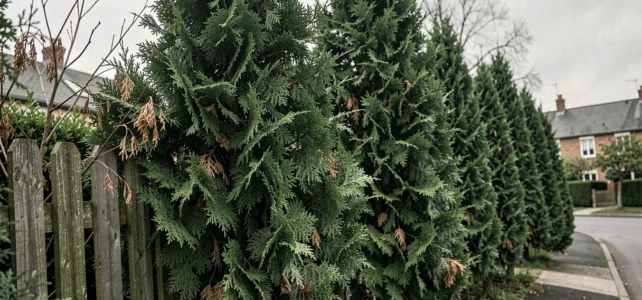
When rebuilding a fence, one consults the local urban planning document of their municipality and discovers that thuja is now prohibited from being planted. The surprise is common because this prohibition does not stem from a national law: it is decided locally, municipality by municipality, with motivations that go beyond mere aesthetic concerns.
Fire risk and thuja: the factor that garden centers do not highlight
In recent years, the issue of thuja’s flammability has emerged in field discussions. Specialized content published in 2026 classifies thuja among the plants monitored for their flammability, with safety distance recommendations around homes.
One quickly understands the problem when realizing that legal obligations for clearing brush apply in more than 7,500 municipalities across 52 departments. In these fire-prone areas, maintaining a dense thuja hedge against a house wall amounts to storing fuel just a few meters from the windows.
Thuja contains resins and oils that are significant in its evergreen foliage. When it dries (which happens increasingly often with drought episodes), it becomes a potential accelerant. To understand the reasons for the prohibition of thuja in France, this fire aspect has become as crucial as the biodiversity argument.
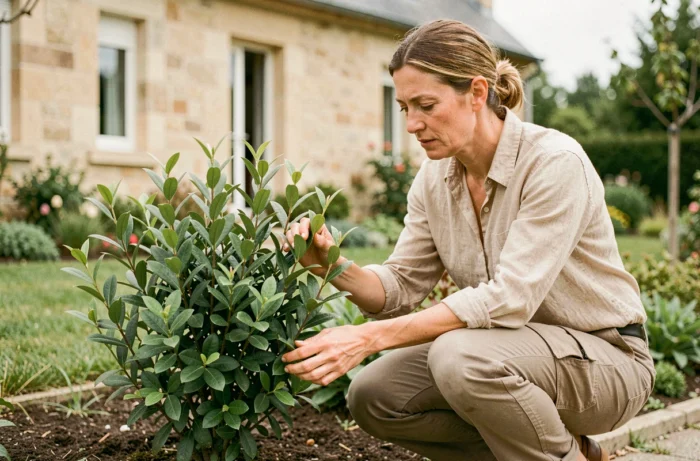
Thuja and biodiversity: impoverished soil under the hedge
The foliage of thuja forms such a dense screen that light hardly penetrates to the base of the hedge. The soil under a line of thujas is often bare, dry, and acidic. The dead leaves of thuja decompose slowly and acidify the earth, which hinders microbial life.
No pollinating insect finds resources in a thuja hedge. No flowers, no berries, no nectar. For birds, it is a poor shelter compared to a mixed hedgerow: no fruits to feed on in winter, no structural diversity for nesting.
The impact on water exacerbates the situation. Thuja is a water-hungry conifer, especially during the summer. In regions where water restrictions are increasing, maintaining a thuja hedge represents a consumption that local authorities find increasingly unacceptable.
What municipalities specifically criticize about thuja
- Soil impoverishment linked to acidification by the needles, preventing other species from settling nearby
- Disproportionate water consumption for a plant that contributes nothing to the local food chain
- A documented potential allergen, with pollen from Thuja occidentalis causing reactions in some sensitive individuals
- An almost irreversible character: the roots of thuja colonize the soil deeply, and uprooting often requires mechanical intervention
Local regulation of thuja: municipal orders and local urban planning
It is reiterated because confusion persists: no national law prohibits thuja in France in 2026. Thuja does not appear on the list of invasive exotic species maintained by the French Office for Biodiversity. The prohibition, when it exists, comes from the municipalities.
The city of Niort is one of the regularly cited examples. Its order prohibits the planting of monospecific thuja hedges on its territory. Other local authorities, such as the community of municipalities of Rives de Saône, have chosen an incentive approach by offering financial assistance covering part of the uprooting cost.
The legal tools used vary. Some municipalities include the prohibition in their Local Urban Planning Plan. Others use specific municipal orders. In areas subject to clearing obligations, thuja can be indirectly targeted by fire prevention rules without a specific order mentioning it.
What one risks concretely in case of non-compliance
Responses on this point vary according to municipalities. In some cases, one receives a simple letter requesting compliance within a given timeframe. In others, financial penalties are foreseen. It is best to check with the town hall before planting or replacing an existing hedge.
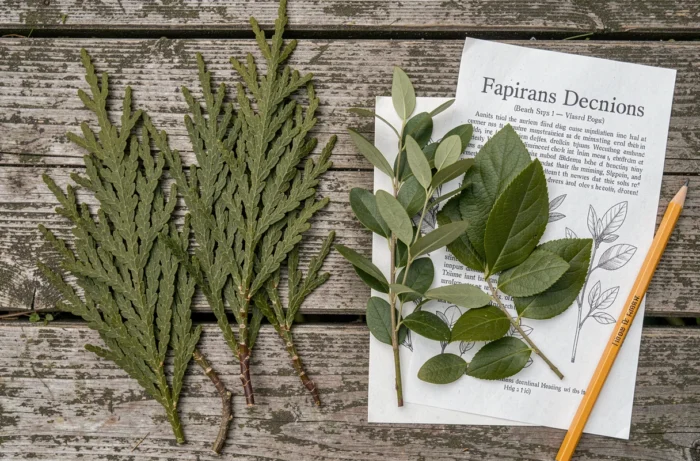
Alternatives to thuja for a dense hedge year-round
Replacing a thuja wall does not mean giving up privacy. Several evergreen shrubs offer a comparable visual screen while nourishing local wildlife.
- Laurel-tin (Viburnum tinus) blooms in winter, produces berries appreciated by birds, and responds well to pruning. Its foliage remains dense year-round without acidifying the soil
- Photinia (Photinia x fraseri) grows quickly, offers red foliage in spring, and requires moderate maintenance. Its water consumption is lower than that of thuja
- Privet (Ligustrum) is a classic of hedgerows. Semi-evergreen depending on the varieties, it accepts severe pruning and attracts pollinators with its fragrant flowering
- Hornbeam (Carpinus betulus), although deciduous, retains its dry leaves for a good part of winter. In a mixed hedge with an evergreen, it provides natural structure and a living soil
A hedge composed of three to four different species will always be more resilient than a monospecific alignment. It is better at resisting pests (a specific parasite does not wipe out the entire hedge at once) and offers flowering spread over several months.
Mixed hedge: the right reflex before replanting
Before uprooting and replanting, check the nature of the soil. Soil that has been under thujas for a long time will likely be acidic. A lime amendment or the addition of mature compost can help rebalance the pH and provide new shrubs with better rooting conditions.
The cost of replacing a thuja hedge depends on the length and accessibility of the land. Some intercommunalities subsidize uprooting and replanting as part of biodiversity programs. Checking for available local aid before starting work can significantly reduce the bill.
Thuja has not disappeared from nurseries, and no one will come to uproot your existing hedge overnight. The underlying trend is clear: municipalities are gradually tightening their rules, and ecological, health, and fire prevention arguments all converge in the same direction. It is better to anticipate replacement than to undergo it under administrative constraint.