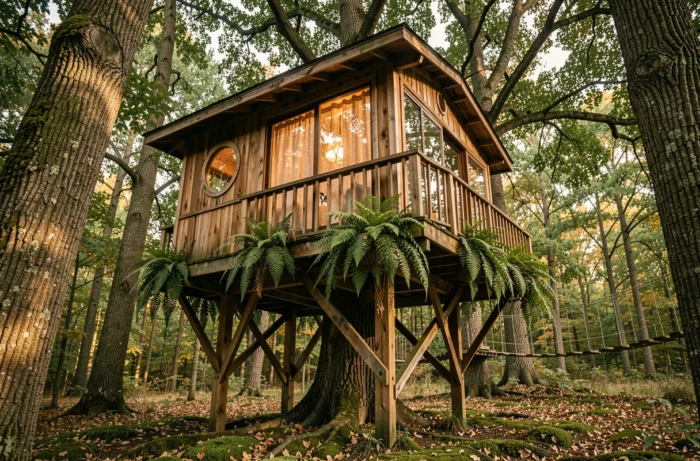
An unusual accommodation refers to any tourist accommodation structure that deviates from the classic hotel model: treehouse, yurt, transparent bubble, caravan, tiny house, or floating lodge. The common point of these formats lies in their location, often in the heart of nature, and a promise of a change of scenery as soon as you cross the threshold. The French market has several thousand of these accommodations, spread across the entire territory.
Legal status of unusual accommodations: what the PLU really changes
Before dreaming of a night under the stars, one point deserves to be made: there is no unique legal status that covers unusual accommodations. The applicable regime depends on the ground area, the fixed or mobile nature of the structure, the declared tourist use, and local zoning.
A yurt set up on a wooden platform, a treehouse screwed into an oak, and a tiny house on a trailer do not fall under the same regulations. The local urban planning plan (PLU) of the municipality remains the reference document to know what is allowed and where.
A mobile tiny house, for example, cannot be freely installed on any private land. When it is classified as a mobile leisure residence, its permanent installation is generally limited to camping grounds, classified holiday villages, or residential leisure parks. The idea of placing it in a garden to rent it out all year round often faces a municipal ban.
On the formalities side, national rules for registering tourist accommodations do not uniformly apply to all unusual formats. Each operator must verify the regime specific to their type of structure rather than assuming that a single declaration is sufficient. To explore accommodation on Terres d’envies, this distinction between legal categories makes perfect sense when comparing the available offers.
Treehouse, bubble, or caravan: criteria for choosing a nature stay
The type of structure conditions the experience well beyond aesthetics. Three concrete criteria help make the decision.
Thermal insulation and season
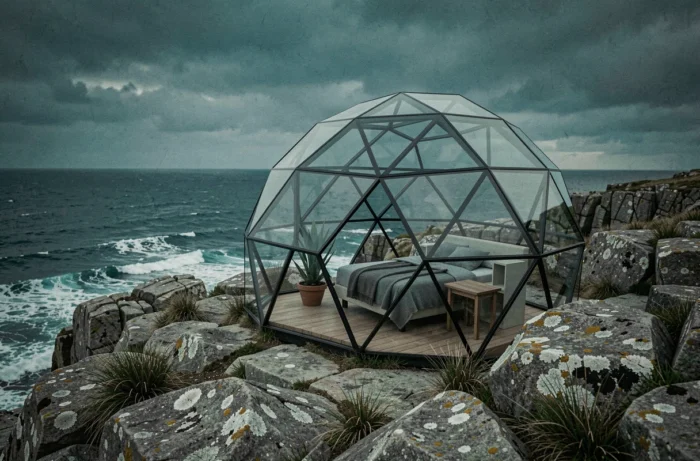
A solid wood cabin retains heat in autumn and winter, whereas a transparent bubble becomes uncomfortable as soon as temperatures drop. Bubbles offer maximum visual immersion (starry sky, canopy), but their use is mainly concentrated in spring and summer in most French regions.
Accessibility and sanitary comfort
A caravan placed on the ground remains accessible without a ladder or walkway, making it suitable for families with young children. Treehouses, on the other hand, often require access via a ladder or suspended staircase, sometimes without integrated sanitation. Checking for the presence of dry toilets or a sanitary block nearby avoids unpleasant surprises upon arrival.
Level of immersion in nature
A floating lodge on a pond provides a radical break from daily life: no road, no neighbors, the sound of water as the only background noise. A yurt set up in a wooded area offers a compromise between comfort (stove, double bed, floor space) and direct contact with the environment.
- Treehouse: high immersion, clear view of the canopy, sometimes sporty access, ideal for couples or an unusual weekend without young children
- Transparent bubble: observation of the night sky, seasonal use, often minimalist comfort, best enjoyed on clear nights and mild temperatures
- Caravan or tiny house: ground-level accessibility, more complete equipment (kitchen, sanitation), possible stay for several nights without loss of comfort
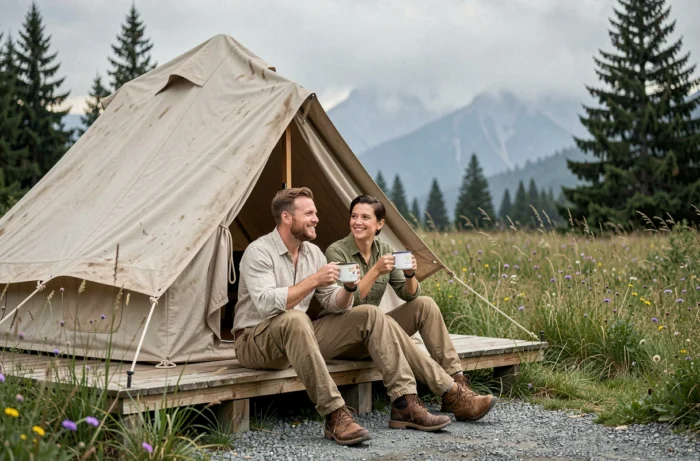
- Yurt: generous interior volume, possible heating with a stove, suitable for families or groups, often located in a park or rural area
Real profitability of unusual accommodation: the trap of occupancy rates
Booking platforms display nightly rates that give the impression of a very profitable activity. The financial reality is more nuanced. A high turnover does not guarantee a positive operating result.
The case of the company Nuits Perchées, whose financial data is public, illustrates this gap. In 2025, the company reported a net turnover of 191,586 euros but a negative operating result of 15,702 euros. Maintenance, insurance, compliance costs, and seasonality weigh heavily on structures exposed to the elements and the accelerated wear of wood, fabrics, or composite materials.
For a project holder, the calculation must include the cost of replacing structural elements (floor, yurt fabric, bubble envelope), the actual duration of the exploitable season, and the average occupancy rate, which remains lower than that of a traditional gîte due to dependence on weather conditions.
Nature stay in France: ecosystems that change the experience
The choice of region radically alters the nature of the stay, far beyond the landscape. Each ecosystem imposes its own constraints and advantages for unusual accommodation.
A domain in Burgundy, in the heart of a wooded park, offers a quiet setting with discreet wildlife (deer, nocturnal raptors). The cabins are often located at the forest edge, away from roads. In comparison, a nature campsite on the Atlantic coast relies on proximity to water but exposes lightweight structures to wind and salt humidity, which accelerates their aging.
Domains located in mid-mountain areas (Auvergne, Vosges, Jura) allow for a four-season stay thanks to moderate temperature variations and dense forest cover that protects the structures. The spa or Nordic bath, often offered as an addition, finds a natural use here: warming up after an autumn hike in an outdoor wood-heated bath prolongs the feeling of immersion.
- Plain forest (Burgundy, Sologne, Dombes): absolute calm, observable wildlife, easy access from major cities
- Mid-mountain (Auvergne, Vosges): four exploitable seasons, hiking nearby, summer freshness
- Coastal or wetland: spectacular landscape, but increased maintenance and more pronounced seasonality
The choice of unusual accommodation for a nature stay is not just a question of aesthetics or trend. The structure, regulatory framework, local ecosystem, and economic viability of the location form a whole that is better examined before booking. A successful stay begins with the right match between the type of structure and the land that hosts it.