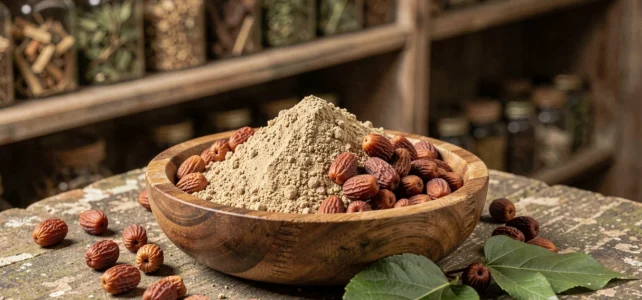
You may have been taking haritaki in capsules or powder for a few weeks, and everything seems to be going well. Smoother digestion, feeling of lightness. The fruit of Terminalia chebula, a pillar of Ayurveda, has a solid reputation. But behind these real benefits lie situations where this plant can cause problems, sometimes seriously.
Laxative effect of haritaki: a question of dose, not nature
Haritaki affects intestinal transit. At a moderate dose, it regulates digestion. At a higher dose, it becomes quite laxative. This is not an accidental side effect: it’s the same mechanism, simply amplified.
The problem arises when one increases the amount of fruit powder without paying attention. Repeated diarrhea can lead to dehydration, especially in the elderly, children, or anyone already weakened. The loss of minerals (potassium, sodium) that accompanies these episodes is not trivial.
When discussing the potential dangers of haritaki, it is often this dose-dependent mechanism that is underestimated. One believes that an Ayurvedic plant is taken “by feel,” but intestinal transit reacts very concretely to the amount ingested.

Haritaki and medications: interactions to watch closely
Are you undergoing treatment for diabetes or taking an anticoagulant? This is where caution becomes non-negotiable.
With hypoglycemic treatments
Haritaki has properties that can lower blood sugar levels. Combined with insulin or a hypoglycemic sulfonamide, the risk of hypoglycemia increases significantly. Interaction sheets (HelloPharmacist) classify this combination as a risky situation requiring medical supervision and possible dose adjustment.
Specifically, if you experience dizziness, cold sweats, or unusual weakness after combining haritaki and antidiabetic treatment, it is probably not a coincidence.
With anticoagulants and antiplatelet agents
The tannins and polyphenols in haritaki exhibit an experimental antiplatelet effect. When combined with warfarin, direct oral anticoagulants, or aspirin, there is a theoretical risk of bleeding. This interaction is classified as moderate in recent literature reviews on Terminalia chebula.
Specialized sources recommend stopping haritaki intake at least two weeks before scheduled surgery. The reason: the combined effects on coagulation are difficult to predict accurately.
Contraindications of haritaki according to health profile
A plant well tolerated by the majority can become problematic for certain profiles. Here are the situations where consuming haritaki warrants prior medical advice:
- Pregnancy and breastfeeding: no reliable clinical data guarantees the safety of haritaki during these periods. Abstention remains the recommended position by specialized sources.
- Individuals on chronic treatment (diabetes, cardiovascular disorders, coagulation disorders): the accumulation of pharmacological effects makes autonomous intake risky.
- People suffering from chronic diarrhea or inflammatory bowel diseases: the laxative effect of the fruit may worsen the situation instead of relieving it.
- Dehydrated children and elderly individuals: the margin of digestive tolerance is narrower, and the consequences of fluid loss are quicker.
The idea that a “natural” plant is suitable for everyone is a dangerous shortcut. Haritaki has real pharmacological activity, and that is precisely what makes it effective, but also potentially harmful.

Quality of haritaki-based supplements: a often overlooked angle
Have you ever closely examined the composition of an organic haritaki dietary supplement in capsules? The concentration of active ingredients varies significantly from one product to another. A standardized extract and a simple powdered fruit do not produce the same effects, nor the same risks.
The lack of standardization makes dosing unpredictable. Two brands selling haritaki powder may offer very different concentrations of gallic acid or chebulinic acid. A user who switches brands without adjusting their dose exposes themselves to notable variations in effect.
Traceability is also a concern. Terminalia chebula primarily grows in India, Nepal, and Sri Lanka. The conditions of harvesting, drying, and storage directly influence the content of active compounds. A poorly stored product may lose some of its properties, or conversely, concentrate certain compounds in an undesirable way.
Haritaki and Triphala: the same precautions apply
Haritaki is one of the three fruits that make up Triphala, a classic formula in Ayurveda. If you consume Triphala, you are consuming haritaki. The drug interactions and digestive risks remain the same, simply diluted by the presence of the other two fruits (amalaki and bibhitaki).
This detail escapes many consumers who take Triphala for the digestive system without realizing that they are accumulating the effects of three active plants. The bleeding risk mentioned for haritaki alone is also documented for Triphala in specialized reviews.
Haritaki remains a plant with documented benefits for digestion and liver health. But these benefits do not exempt one from a rigorous approach. Any regular intake should be discussed with a healthcare professional, especially if a medication is being taken. The line between useful dose and problematic dose is sometimes thinner than one might think.