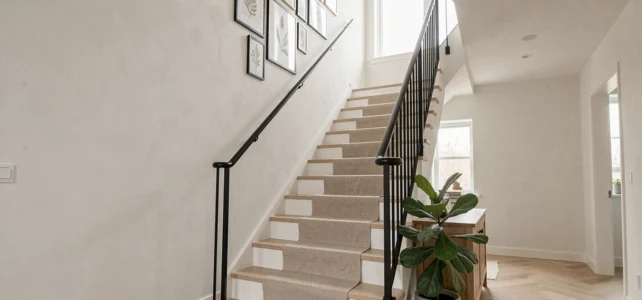
The staircase area often has a wall surface larger than that of a living room, yet it is treated like a simple corridor. Decorating this vertical space transforms the perception of the entire house. Here are some concrete ideas to modernize your staircase without undertaking major renovations.
Terracotta and off-white palette to warm up the staircase
Have you noticed that pure white walls give a clinical look to narrow spaces? The decor trends for 2025-2026 offer an alternative. The Pantone shade “Cloud Dancer” (a bright off-white) replaces cold white in hallways and landings.
The idea is simple: apply this off-white to most of the walls in the staircase, then reserve one wall or the risers for terracotta, ochre, or clay tones. This combination avoids the corridor effect while bringing warmth that pure white cannot offer.
To delve deeper into the choice of combinations, Cherry Déco’s decor tips detail several color arrangements suitable for this type of space. Adding a deep blue-green on the lower part of the wall (in a painted base) creates a modern contrast with the earthy tones above.
Recessed LED lighting in the steps: standards and implementation
Installing LED strips along the steps radically changes the atmosphere of a staircase, especially in the evening. Before drilling or gluing anything, a technical point deserves your attention.
The NF C 15-100 standard requires a control point at the top and bottom of each staircase. In practical terms, this means a two-way switch or a push-button switch. If you add LED lighting as a supplement, it must adhere to this control logic from both levels.
On the practical side, aluminum profiles recessed into the step nosing protect the LED strip and diffuse light without glare. Prefer a color temperature around warm white to maintain consistency with an earthy palette.
Panoramic wallpaper in the staircase: the wall as a canvas
Panoramic wallpaper takes advantage of the ceiling height that the staircase naturally offers. A single panoramic strip applied to the main wall creates a visual effect comparable to a mural, without the budget of an artist.
Choosing the right wall for the panoramic wallpaper
The wall most visible from the entrance landing is the ideal candidate. If your staircase turns, the wall of the intermediate landing works just as well. The goal is for the pattern to be readable at a glance when looking up.
Patterns suitable for vertical spaces
Forest scenes, mountainous landscapes, or stylized plant compositions take advantage of verticality. Repetitive geometric patterns, on the other hand, sometimes accentuate the feeling of height in an uncomfortable way.
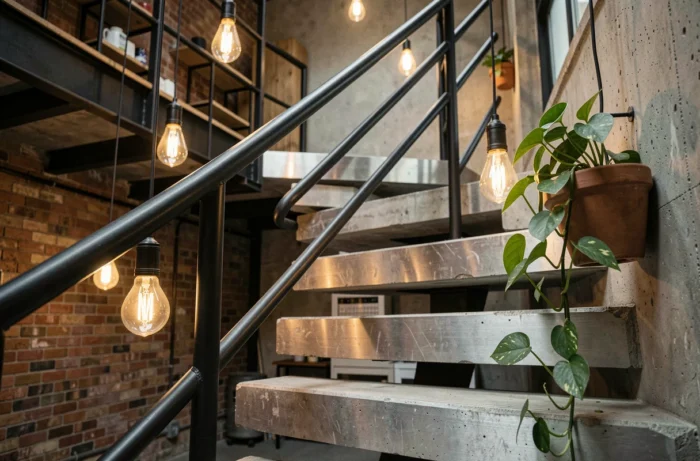
- A plant-dominant panoramic wallpaper softens a concrete or metal staircase and compensates for the lack of natural light.
- An architectural pattern (arches, colonnades) suits wide staircases with depth.
- Abstract designs in neutral tones integrate into a minimalist interior without visually saturating the space.
Dressing staircase walls with wood: slats and fluted panels
Vertical wooden slat interior cladding is experiencing a resurgence of interest in circulation spaces. Installed on a single wall of the staircase, the slats create relief and absorb some of the footsteps’ noise.
Raw wood (oak, beech, or pine depending on the budget) can remain natural with a simple matte varnish. For a more contemporary look, a stain in a clay or light gray tone matches the earthy palette mentioned earlier.
Fluted panels offer a quicker alternative to install. Sold in grooved MDF panels, they attach directly to the wall with mounting glue. The result is similar to slats, with fewer cuts to manage.
Decorative risers and sleek railings: two details that change everything
Before repainting an entire wall, take a look at your staircase’s risers. Painting each riser in a different tone (a gradient from ochre to terracotta, for example) transforms the staircase itself into a decorative element. Painted risers replace a stair carpet at a lower cost.
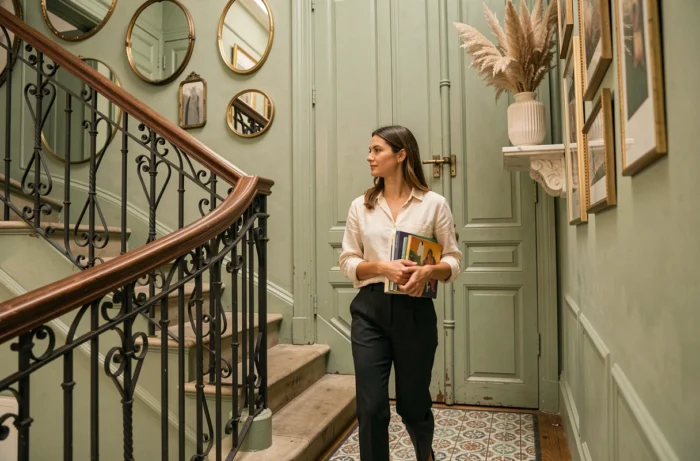
The railing also plays a major role in the perception of modernity. Replacing turned wooden spindles with a railing made of tensioned cables or tempered glass visually lightens the entire staircase. Glass, in particular, allows light to pass through and enlarges the perceived space.
- Horizontal stainless steel cables: industrial look, compatible with a wooden or metal staircase.
- Tempered glass with point fixings: minimalist look, suitable for contemporary interiors.
- Laser-cut metal (geometric or plant patterns): a more decorative option that filters light in an original way.
Greening the staircase without cluttering the steps
Hanging trailing plants from the upper landing takes advantage of the available height. A pothos or ivy in suspension naturally grows downwards and adorns the central void of the staircase.
Fixing pots to the ceiling or railing frees up the steps and avoids any obstacles in the passage. Wall-mounted supports shaped like a half-circle, screwed along the ascent, accommodate small pots without encroaching on the circulation width.
For poorly lit staircases, golden pothos and philodendrons tolerate semi-shade well. Combined with a slatted wood wall, they enhance the organic atmosphere without requiring complex maintenance.
Each staircase has its constraints: height, width, brightness, style of the rest of the house. The most effective approach is often to combine two or three of these strategies (color palette, lighting, a textured material) rather than changing everything at once. A panoramic wall combined with LED lighting in the step nosing is enough to make a mundane staircase unrecognizable.